

…the primary human motivations are…
…food, sleep and sex…
…feeble human mores are no match for…
…hunger for food…
…the need to sleep and…
…the urge to merge…
…you will never stop the hormonal tides…
…insemination will result in pregnancies…
…does a zygote rise to the level of “human being?”…
…shall we endow a microscopic cell mass with “full human rights?”
…shall we force every impregnated women to carry to full term and give birth?…
…perhaps we should offer free and available birth control instead and…
…counsel women on how to prevent unwanted pregnancies…
…no one should be using abortion as a form of “birth control”…
…pro-life…pro-choice…both want to reduce abortions…
…anti-choice…pro-abortion…are “loaded words”…
…who wants an abortion?…
…nobody…wants an abortion…
…why do women have abortions?…
…mostly one reason…an unwanted pregnancy…
…why are there unwanted pregnancies?…
…the mistake is getting pregnant when you don’t want to…
…abstinence, sex education and birth control products…
…are the only ways to prevent unwanted pregnancies…
…shouldn’t we employ every practical method to reduce abortions?…
…if you are pro-life or pro-choice you have an obligation to support sex education and the availability of free birth control for the prevention of unwanted pregnancies…in addition to this you have an obligation to protest and vote against:
the global arms trade…
the death penalty…
the war machine and all war…
…to reduce abortions we must prevent unwanted pregnancies with:
abstinence education…
detailed sex education…
readily available birth control products for free…
state supported womens clinics for reproductive health…
…abortions have declined worldwide as access to family planning education and contraceptive services has increased.
(reprinted from may 7, 2009)
[NOTE: If anyone is interested, this is post #500 in the Globalove Think Tank!]
Before I start, let me say that in writing about the Taliban, I am not indicting the Muslim community, which has many good, upright adherents, some of whom I am honoured to include among my friends. Please do not construct anything I say about Taliban to apply to the millions of Muslims who are peaceful, constructive and valued citizens of countries all over the world.
Do to a certain shallow, outward physical resemblance to some Muslim extremists, our Sikh community has been under attack since the 9/11 terrorist attacks by those who don’t know any better. Now events in Pakistan, where the Taliban has attacked the Sikhs of the SWAT Valley, forcing them out of their homes, make a comparison of the two groups mandatory for anyone who really wants to understand world events. (And to stop picking on innocent Sikhs, as well.)
First, what exactly happened in Pakistan? The government there has effectively turned over control of a region in the north of the country, the SWAT Valley, over to the Taliban. In a region of this valley called Orakzai live – or rather lived – a few Sikh families. These were poor Sikh farmers who had lived in peace with their neighbours for generations, who had chosen to stay in Pakistan when most Sikhs left to move to India in the Partition of 1948. These are people with few material resources who clearly love their homes and simple way of life.

These were destroyed when the Taliban demanded that they pay a tax on non
Muslims, called a Jaziya. I have read that jaziya was originally paid by nonMuslims in lieu of military service. I have also read that it was originally a financial inducement to convert to Islam. Whatever the original purpose, in this instance, it is clearly simple extortion, not unlike “protection money” paid by business owners to organised crime to insure that the Mob will leave their businesses alone.
The amount demanded by the Taliban, was beyond the means of the community and when it was not paid, the houses of the Sikhs were razed and Sikh businesses were occupied. The Sikhs, seeing yet another massacre looming, fled with little more than the clothes on their backs and a few meager possessions.
Lahore: The Taliban has expelled at least 50 Sikh families from the
Orakzai Agency in the Federally Administered Tribal Areas (FATA) after
they failed to pay ‘Jazia’. The Taliban had demanded 12 million rupees ($242,840, GBP 161,271)
as protection money from the Sikhs, who have living in the region from
hundred of years, but they could arrange only 6.7 million rupees.($135,586, GBP 87,355)Later, it was reported that the extremists occupied houses and shops
of the Sikhs in Qasim Khel and Feroz Khel areas of the Agency and
auctioned their valuables for 0.8 million rupees ( $16,190, GBP 10,750), The Daily Times
reports. Earlier, the Taliban had also demolished houses belonging to
the Sikh community in the region.The Taliban’s Orakzai Agency chief Hakeemullah Mehsud ordered the
demolition of the houses after the Sikhs failed to meet a deadline
fixed for payment.
Having established, I hope, that Sikhs are not Muslim extremists, who then are Sikhs? Briefly, a Sikh is a follower of Sikhi or Sikhism, a panentheistic (look it up!), monotheistic religion that originated in Punjab, in what is now northeastern India and southwestern Pakistan. Rather than summarise the beliefs, which is really beyond the scope of this article, I suggest you go to about.Sikhism and look around. It’s interesting and educational.
The religion sprung up and developed at a time when Mughals (Muslims) had imposed a brutal dictatorship on the people of part of what is now called “the Asian subcontinent,” that is India and Pakistan. I will now compare some aspects of Taliban and Sikhs.
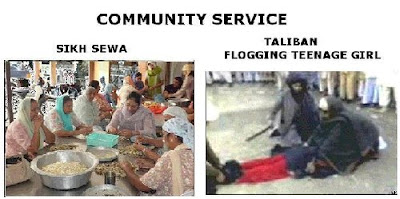
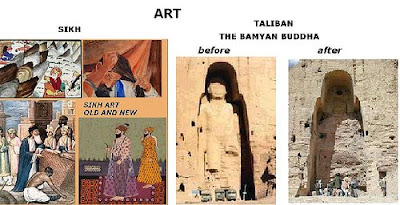
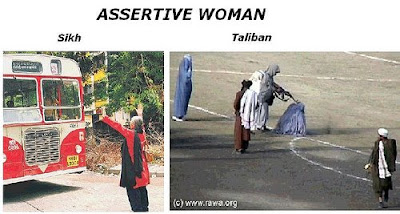
Since people are generally more visual than verbal, I have included a picture gallery of major differences between the two groups below.
There is a certain superficial physical resemblance. The men of both groups grow beards and wear turbans. The majority of members of both groups are brown. The Taliban, however, are by and large Arabs, with Middle Eastern origins. Although there is a growing number of Sikhs of European and African descent, most Sikhs today are still either Punjabis or descendants of Punjabis.
Taliban discriminate against women in many ways: imposing Muslim dress which completely covers her, denies her education, restricts her movements so she is not allowed to go outside unless accompanied by a male relative. (I wonder what happens to a woman who has no male relatives?)
Sikhi teaches that men and women are equals. In fact, the Sikh Rehat Maryada – the Sikh Code of Conduct – forbids a woman to cover her face.
Here is an example of Sikh music, a sort of hymn called a kirtan. Notice that it has a happy sound and is a joy to hear! Also notice that it is sung by a woman!
I cannot give an example of Taliban music, since the Taliban ban music entirely, even to the point of killing songbirds when they controlled Afghanistan.
I cannot give a current example of Sikh government, since the Sikh Empire (1799-1849) governed by Maharaja Ranjit Singh is no longer around. However, two big differences between Sikh rule at that time and Taliban rule now are that capital punishment did not exist in the Sikh Empire, while it is common among the Taliban. And a huge difference, different religions were not only tolerated in the Sikh Empire but were actually respected, while the Taliban not only lack respect or tolerance for other religions, but also condemn all other forms of Islam, their own religion.
But enough of words. I have written enough to tell about the differences, now a few pictures to show the differences.




Note: Should anyone wish to reproduce this post, I will be happy to send you the html to make it easy for you. Just leave your e-mail in a comment or e-mail me at simayanan [at] gmail [dot] com. MHK


Is Bradley Manning a traitor or hero ?
OSLO, Norway — The Nobel Peace Prize jury has received 231 nominations for this year’s award, a spokesman said, with publicly disclosed candidates including a former Ukrainian prime minister and the U.S. soldier accused of leaking classified material to WikiLeaks.
The secretive committee doesn’t reveal who has been nominated, but those with nomination rights sometimes announce their picks.
Names put forward this year include Bradley Manning, the U.S. Army private charged with the biggest leak of classified information in U.S. history, Russian human rights activist Svetlana Gannushkina and former Ukrainian Prime Minister Yulia Tymoshenko. (huffington post)

Remember…
no matter where YOU go…
there YOU are.

Alfred Charles Kinsey (June 23, 1894 â August 25, 1956) was an American biologist and professor of entomology and zoology, who in 1947 founded the Institute for Sex Research at Indiana University, now known as the Kinsey Institute for Research in Sex, Gender, and Reproduction, as well as producing the Kinsey Reports and the Kinsey scale. Kinsey’s research on human sexuality, foundational to the modern field of sexology, provoked controversy in the 1940s and 1950s. His work has profoundly influenced social and cultural values in the United States and many other countries. (read more)
The Kinsey Reports are two books on human sexual behavior, Sexual Behavior in the Human Male (1948) and Sexual Behavior in the Human Female (1953), by Dr. Alfred Kinsey, Wardell Pomeroy and others and published by Saunders. Kinsey was a zoologist at Indiana University and the founder of the Kinsey Institute for Research in Sex, Gender and Reproduction (more widely known as the Kinsey Institute).
The Sexual Behavior in the Human Female was based on personal interviews with nearly 6,000 women. Kinsey analyzed data on the frequency with which women participate in various types of sexual activity and looked at how factors such as age, social-economic status and religious adherence influence sexual behavior. Comparisons are made of female and male sexual activities. Kinsey’s evidence suggested that women were less sexually active than men in all aspects of sexual life but that they were still more sexual than traditional views allowed. By the time the book on female sexuality was published, it appeared that Kinsey seemed to feel that women and men are more alike in the biology of their sexuality than he had previously thought, and that both men’s and women’s sexuality seemed shaped, not merely repressed, by social and cultural forces.
The publications astounded the general public and were immediately controversial and sensational. The findings caused shock and outrage, both because they challenged conventional beliefs about sexuality and because they discussed subjects that had previously been taboo. (read more)


Time Saving Truth from Falsehood and Envy
François Lemoyne, 1737
However, language and words are essentially “tools” by which humans convey information to one another. As such, “truth” must have a beneficial use in order to be retained within language. Defining this potency and applicability can be looked upon as “criteria”, and the method used to recognize a “truth” is termed a criteria of truth. Since there is no single accepted criteria, they can all be considered “theories”.
Various theories and views of truth continue to be debated among scholars and philosophers. There are differing claims on such questions as what constitutes truth; what things are truthbearers capable of being true or false; how to define and identify truth; the roles that revealed and acquired knowledge play; and whether truth is subjective, relative, objective, or absolute.
This article introduces the various perspectives and claims, both today and throughout history. (read more)
The greatest failure is the failure of the imagination; the inability to think that things can be other than they are; the lack of openness to the deeper layers of the human psyche; the unquestioning of all too popular assumptions; the ready acceptance of the lies that all vested interests in society tell and the deadening and depressing thought that nothing will ever change.
 |
| The Wave, 1971 by the sculptor Sinisca, Vatican Museum. |
Many years ago I heard one of our Irish Senators say that the reason there was so much bloodshed on the streets of the North of Ireland (happily now a nightmare from the past and long gone!)could be directly attributed to a singular lack of imagination. How accurate this politician was – Senator David Norris – veritably goes without saying. When imagination fails, or is not even tried in the first place, then all mediation and dialogue which are the essence of diplomacy are committed to the dunghill of failure. Conflict at all levels – familial, national and international – is the result of the brekdown in our ability to imagine that things can be different, that dreams of peace and harmony are possible, that they are not just pipe dreams or pie in the sky.
What is greatly needed today on all levels of society – in local communities, in cities, in towns, in clubs and indeed in countries and in international affairs are statesmen and stateswomen with imagination, people with dreams and visions that are realizable, practicable, and feasible. But, I suppose, all real change starts at the bottom, in local communities, in our very own families, where we encourage each other to follow our dreams; where we encourage each other that we can make a difference here and now where we are, that as the Bard of Avon once said, that “we are the stuff that dreams are made on,” that humankind can redeem itself as well as wreaking sheer havoc, if not possible extinction, upon itself if only it has the courage to dream that things can be different.
I’ll finish this wee post with one of my favourite quotations:
Some people see things as they are and say why. I dream things that never were and say why not. Robert Kennedy on his brother JFK; original quote from G.B.Shaw.


Anthony Caponi is an artist, educator, poet, philosopher, innovator and engineer. For 60 years, Caponi has lived, worked, taught, and created his art in Minnesota. His distinguished career has carved an indelible mark in the cultural history of the state and contributed immeasurably to the wealth of arts available to its citizens.
At age 88, Caponi continues to create with energy and inspiration. Caponi Art Park and Learning Center, the manifestation of his 50-year vision, has been a reality since 1992. This vision and creative spirit have built and literally sculpted this public creation for the delight of everyone. The concrete and dirt paths are Caponiâs linear drawings retraced and animated by each person who walks them. The rock walls and shaped earth are his 60-acre sculpture into which conventional works are integrated. Since making a home in Eagan in 1949, the realization of Caponi Art Park crowns his lifeâs achievements.

Without plucking a leaf or leaving a body in want
I take from life.
I take all I can and give it all back with a personal flavor.
I rub softness into granite; knead clay to free from it a
form that becomes, with the life it takes.
To give ideas a body, to animate a body with spirit,
I sculpt.
To share the pleasure of transforming the mindâs ghosts
into caressable shapes,
I teach.
I teach the unzipping of the inner layer of the mind
where experience ferments and nourishes judgment,
where the soul expands and swells the vents of expression,
flavoring existence with shared feelings.
I teach the fusion of mind and touch, so not to divorce understanding from the sensuous rewards of knowing.

(photograph by Oberon)
The World Ocean School
is an internationally focused nonprofit,
nonsectarian organization dedicated to providing
challenging educational programs aboard the schooner Roseway.


The Whole Earth Catalog was an American counterculture catalog published by Stewart Brand between 1968 and 1972, and occasionally thereafter, until 1998. Although the WECs listed all sorts of products for sale (clothing, books, tools, machines, seeds — anything for a self-sustainable “hippie” lifestyle) the Whole Earth Catalogs themselves did not sell any of the products. Instead the vendors and their prices were listed right alongside with the items. This led to a need for the Catalogs to be frequently updated.
Apple Inc. founder and entrepreneur Steve Jobs has described the Catalog as the conceptual forerunner of the World Wide Web.
The title Whole Earth Catalog came from a previous project of Stewart Brand. In 1966, he initiated a public campaign to have NASA release the then-rumored satellite photo of the sphere of Earth as seen from space, the first image of the “Whole Earth.” He thought the image might be a powerful symbol, evoking a sense of shared destiny and adaptive strategies from people. The Stanford-educated Brand, a biologist with strong artistic and social interests, believed that there was a groundswell of commitment to thoroughly renovating American industrial society along ecologically and socially just lines, whatever they might prove to be. (read more)
Sir Isaac Newton (4 January 1643 â 31 March 1727) was an English physicist, mathematician, astronomer, natural philosopher, alchemist, and theologian who is perceived and considered by a substantial number of scholars and the general public as one of the most influential scientists in history.
His 1687 publication of the Philosophiæ Naturalis Principia Mathematica (usually called the Principia) is considered to be among the most influential books in the history of science, laying the groundwork for most of classical mechanics. In this work, Newton described universal gravitation and the three laws of motion which dominated the scientific view of the physical universe for the next three centuries.
Newton showed that the motions of objects on Earth and of celestial bodies are governed by the same set of natural laws by demonstrating the consistency between Kepler’s laws of planetary motion and his theory of gravitation, thus removing the last doubts about heliocentrism and advancing the scientific revolution.

“I do not know what I may appear to the world,
but to myself I seem to have been only like a boy
playing on the sea-shore, and diverting myself
in now and then finding a smoother pebble
or a prettier shell than ordinary,
whilst the great ocean of truth
lay all undiscovered before me.”
Sir Isaac Newton

I can fly
I can make a machine
I can make it fly
I can leave the earth
I can soar above the clouds
I can reach the heavens
I learned to fly when I was 6 years old
I can fly

“There is nothing new in the world
except the history you do not know.”
Harry S. Truman