


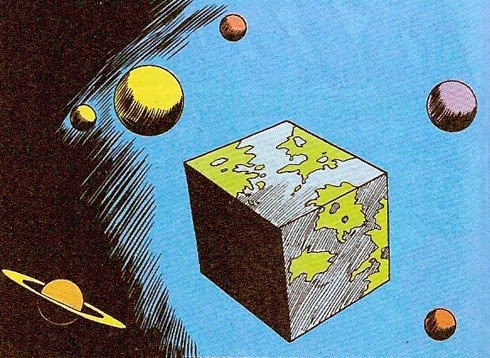
Far out in space there exists the goofiest planet in the entire universe…the square BIZARRO WORLD known as earth ! It is the home planet of the pathetic, stupid human creatures who are the bane of the galaxy. They kill each other at an ever increasing rate, they poison the air, the water and the land of their beautiful world with their pollution and trash, and they use the ocean as their toilet. They commit suicide without even knowing it. They do everything wrong, it is as if their brains are broken but if truth be told it is that they have eyes but cannot see. I do not know how long they will last.



Stanley Kubrick (July 26, 1928 â March 7, 1999) was an American film director, writer, producer, and photographer who lived in England during most of the last four decades of his career. Kubrick was noted for the scrupulous care with which he chose his subjects, his slow method of working, the variety of genres he worked in, his technical perfectionism, and his reclusiveness about his films and personal life. He maintained almost complete artistic control, making movies according to his own whims and time constraints, but with the rare advantage of big-studio financial support for all his endeavors.
Kubrick’s films are characterized by a formal visual style and meticulous attention to detailâhis later films often have elements of surrealism and expressionism that eschews structured linear narrative. His films are repeatedly described as slow and methodical, and are often perceived as a reflection of his obsessive and perfectionist nature. A recurring theme in his films is man’s inhumanity to man. While often viewed as expressing an ironic pessimism, a few critics feel his films contain a cautious optimism when viewed more carefully.
The film that first brought him attention to many critics was Paths of Glory, the first of three films of his about the dehumanizing effects of war. Many of his films at first got a lukewarm reception, only to be years later acclaimed as masterpieces that had a seminal influence on many later generations of film-makers. Considered especially groundbreaking was 2001: A Space Odyssey noted for being both one of the most scientifically realistic and visually innovative science-fiction films ever made while maintaining an enigmatic non-linear storyline. He voluntarily withdrew his film A Clockwork Orange from England, after it was accused of inspiring copycat crimes which in turn resulted in threats against Kubrick’s family. His films were largely successful at the box-office, although Barry Lyndon performed poorly in the United States. Living authors Anthony Burgess and Stephen King were both unhappy with Kubrick’s adaptations of their novels A Clockwork Orange and The Shining respectively, and both authors were engaged with subsequent adaptations. All of Kubrick’s films from the mid-1950s to his death except for The Shining were nominated for Oscars, Golden Globes, or BAFTAs. Although he was nominated for an Academy Award as a screenwriter and director on several occasions, his only personal win was for the special effects in 2001: A Space Odyssey.
Even though all of his films, apart from the first two, were adapted from novels or short stories, his works have been described by Jason Ankeny and others as “original and visionary”. Although some critics, notably Andrew Sarris and Pauline Kael, frequently disparaged Kubrick’s work, Ankeny describes Kubrick as one of the most “universally acclaimed and influential directors of the postwar era” with a “standing unique among the filmmakers of his day.”

We haven’t made much progress.
CENSORED 2012 â
In this volume, there are 500 pages of real news you can use, plus ample analysis that eradicates civil paralysis, and antidotes to our current Truth Emergency that will strengthen societal media literacy.
The mission of Project Censored is to teach students and the public about the role of a free press in a free society â and to tell the News That Didnât Make the News and Why
Between 700 and 1000 stories are submitted to Project Censored each year from journalists, scholars, librarians, and concerned citizens around the world.
With the help of more than 200 Sonoma State University faculty, students, and community members, Project Censored reviews the story submissions for coverage, content, reliability of sources and national significance. The university community selects 25 stories to submit to the Project Censored panel of judges who then rank them in order of importance. Current or previous national judges include: Noam Chomsky, Susan Faludi, George Gerbner, Sut Jhally, Frances Moore Lappe, Michael Parenti, Herbert I. Schiller, Barbara Seaman, Erna Smith, Mike Wallace and Howard Zinn. All 25 stories are featured in the yearbook, Censored: The News That Didnât Make the News.
see > Top 25 Of 2012 (“Censored 2012: Stories of 2010-2011”)
The Sourcebook for the Media Revolution, The Top Censored Stories and Media Analysis of 2010-2011 by Mickey Huff and Project Censored.

Project Censored is administered through the SSU Sociology Department with financial support from the SSU Instructionally Related Activity Fund, School of Social Science, Media Freedom Foundation Inc. and donations from thousands of supporters around the country.
see also > Top 25 Archive
Independent News Sources
Featured Articles
Censored Notebook

Duâa Khalil Aswad (دعاء Ø®ÙÙ٠أسÙد)(c. 1989 â c. April 7, 2007) was a 17-year-old Iraqi Kurd of the Yazidi faith who was stoned to death in an honor killing. It is believed that she was killed around April 7, 2007, but the incident did not come to light until video of the stoning, apparently recorded on a mobile phone, appeared on the Internet. The rumor that the stoning was connected to her alleged conversion to Islam prompted heavy reprisals against Yazidis by Sunni extremists, including the 2007 Mosul massacre.
Aswad was taken to the town square and reports at the time alleged that she was stripped of her clothing down to her undergarments to symbolize that she had dishonored her family and religion. During the stoning, which lasted approximately thirty minutes, Aswad can be seen in the video attempting to sit up and calling for help as the crowd taunts her and repeatedly throws a large chunk of rock or concrete on her head. After her death in the town square, Aswad’s body was tied behind a car and dragged through the streets. She was buried with the remains of a dog, allegedly to demonstrate that she was worthless. Eventually, her body was “exhumed and sent to the Medico-Legal Institute in Mosul so that tests could be performed to see whether she had died a virgin, results had then come back that confirm that she was in fact still a virgin.” (read more)

The I-35W Mississippi River bridge (officially known as Bridge 9340) was an eight-lane, steel truss arch bridge that carried Interstate 35W across the Mississippi River in Minneapolis, Minnesota, United States. During the evening rush hour on August 1, 2007, it suddenly collapsed, killing 13 people and injuring 145. The bridge was Minnesota’s fifth busiest, carrying 140,000 vehicles daily. The NTSB cited a design flaw as the likely cause of the collapse, and asserted that additional weight on the bridge at the time of the collapse contributed to the catastrophic failure.

In the years prior to the collapse, several reports cited problems with the bridge structure. In 1990, the federal government gave the I-35W bridge a rating of “structurally deficient,” citing significant corrosion in its bearings. Approximately 75,000 other U.S. bridges had this classification in 2007. According to a 2001 study by the civil engineering department of the University of Minnesota, cracking had been previously discovered in the cross girders at the end of the approach spans. The main trusses connected to these cross girders and resistance to motion at the connection point bearings was leading to unanticipated out-of-plane distortion of the cross girders and subsequent stress cracking. In 2005, the bridge was again rated as “structurally deficient” and in possible need of replacement, according to the U.S. Department of Transportation’s National Bridge Inventory database.


