

“The more you know,
the crazier you look.”

We will all get old
We will all get sick
And we will all die



I have no country to die for.
My country is the earth.
I am a citizen of the world
which consists of only one race
…the human race.
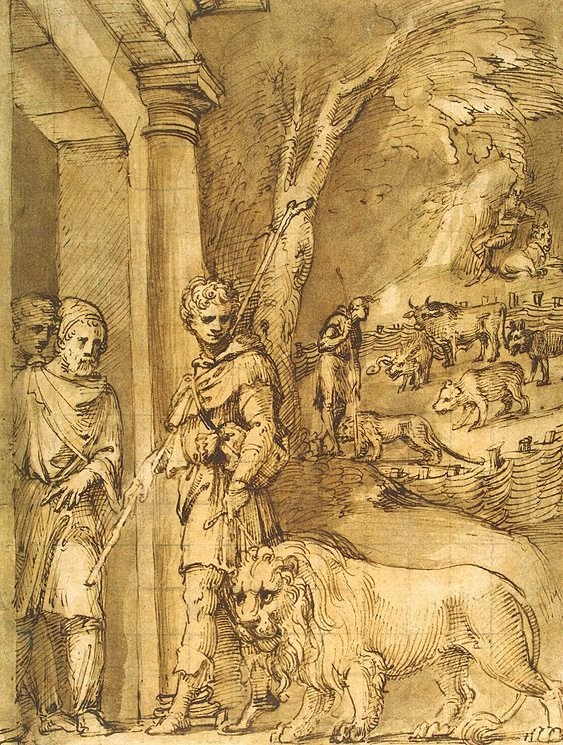
The earliest form of the story is found in the fifth book of Aulus Gellius’s 2nd century Attic Nights. The author relates there a story told by Apion in his lost work Aegyptiacorum (“Wonders of Egypt”), the events of which Apion claimed to have personally witnessed in Rome. In this version, Androcles is given the Latin name of Androclus, a runaway slave of a former Roman consul administering a part of Africa. He takes shelter in a cave, which turns out to be the den of a wounded lion. He removes a large thorn from the animal’s foot pad, forces pus from the infected wound, and bandages it. As a result, the lion recovers and becomes tame toward him, acting like a domesticated dog, including wagging its tail and bringing home game that it shares with the slave.
After several years, the slave eventually craves a return to civilization, resulting in his imprisonment as a fugitive slave and condemnation to be devoured by wild animals in the Circus Maximus of Rome. In the presence of an unnamed emperor, presumably either Caligula or Claudius, the most imposing of these beasts turns out to be the same lion, which again displays its affection toward the slave. The emperor pardons the slave on the spot, in recognition of this testimony to the power of friendship, and he is left in possession of the lion. Apion then continues:
“Afterwards we used to see Androclus with the lion attached to a slender leash, making the rounds of the tabernae throughout the city; Androclus was given money, the lion was sprinkled with flowers, and everyone who met them anywhere exclaimed, This is the lion, a man’s friend; this is the man, a lion’s doctor.” (read more)

According to Michael Onyebuchi Eze, the core of ubuntu can best be summarized as follows:
“A person is a person through other people” strikes an affirmation of oneâs humanity through recognition of an “other” in his or her uniqueness and difference.
It is a demand for a creative intersubjective formation in which the “other” becomes a mirror (but only a mirror) for my subjectivity.
This idealism suggests to us that humanity is not embedded in my person solely as an individual; my humanity is co-substantively bestowed upon the other and me.
Humanity is a quality we owe to each other. We create each other and need to sustain this otherness creation.
And if we belong to each other, we participate in our creations: we are because you are, and since you are, definitely I am.
The “I am” is not a rigid subject, but a dynamic self-constitution dependent on this otherness creation of relation and distance”.




Andrew Samuel “Andy” Griffith (June 1, 1926 â July 3, 2012) was an American actor, director, producer, Grammy Award-winning Southern-gospel singer, and writer. A Tony Award nominee for two roles, he gained prominence in the starring role in director Elia Kazan’s film A Face in the Crowd (1957) before he became better known for his television roles, playing the lead characters in the 1960â1968 situation comedy The Andy Griffith Show and in the 1986â1995 legal drama Matlock. Griffith died on July 3, 2012 at the age of 86. (read more)

RMS Titanic was a passenger liner that sank in the North Atlantic Ocean on 15 April 1912 after colliding with an iceberg during her maiden voyage from Southampton, England to New York City. The sinking of Titanic caused the deaths of 1,514 people in one of the deadliest peacetime maritime disasters in history. She was the largest ship afloat at the time of her maiden voyage. One of three Olympic class ocean liners operated by the White Star Line, she was built between 1909â11 by the Harland and Wolff shipyard in Belfast. She carried 2,223 people.

Her passengers included some of the wealthiest people in the world, as well as over a thousand emigrants from Great Britain and Ireland, Scandinavia and elsewhere seeking a new life in North America. The ship was designed to be the last word in comfort and luxury, with an on-board gymnasium, swimming pool, libraries, high-class restaurants and opulent cabins. She also had a powerful wireless telegraph provided for the convenience of passengers as well as for operational use. Though she had advanced safety features such as watertight compartments and remotely activated watertight doors, she lacked enough lifeboats to accommodate all of those aboard. Due to outdated maritime safety regulations, she carried only enough lifeboats for 1,178 people â slightly more than half of the number traveling on the maiden voyage and one-third her total passenger and crew capacity.

After leaving Southampton on 10 April 1912, Titanic called at Cherbourg in France and Queenstown (now Cobh) in Ireland before heading westwards towards New York. On 14 April 1912, four days into the crossing and about 375 miles (600 km) south of Newfoundland, she hit an iceberg at 11:40 pm (ship’s time; GMTâ3). The glancing collision caused Titanic’s hull plates to buckle inwards in a number of locations on her starboard side and opened five of her sixteen watertight compartments to the sea. Over the next two and a half hours, the ship gradually filled with water and sank. Passengers and some crew members were evacuated in lifeboats, many of which were launched only partly filled. A disproportionate number of men â over 90% of those in Second Class â were left aboard due to a “women and children first” protocol followed by the officers loading the lifeboats. Just before 2:20 am Titanic broke up and sank bow-first with over a thousand people still on board. Those in the water died within minutes from hypothermia caused by immersion in the freezing ocean. The 710 survivors were taken aboard from the lifeboats by RMS Carpathia a few hours later. (read more)

This is the back of my Ford F-150 pickup…
and this is my message to the world…
What’s your message?

19 Revenge not yourselves, my dearly beloved; but give place unto wrath, for it is written: Revenge is mine, I will repay, saith the Lord.
20 But if thy enemy be hungry, give him to eat; if he thirst, give him to drink. For, doing this, thou shalt heap coals of fire upon his head.
21 Be not overcome by evil, but overcome evil by good.


Andrew Aitken “Andy” Rooney (January 14, 1919 â November 4, 2011) was an American radio and television writer. He was most notable for his weekly broadcast “A Few Minutes with Andy Rooney”, a part of the CBS News program 60 Minutes from 1978 to 2011. His final regular appearance on 60 Minutes aired October 2, 2011. He died a month later, on November 4, at age 92.
Andrew Rooney was born in Albany, New York, the son of Walter Scott Rooney (1888â1959) and Ellinor (née Reynolds) Rooney (1886â1980). He attended The Albany Academy, and later attended Colgate University in Hamilton in Central New York, where he was initiated into the Sigma Chi fraternity, until he was drafted into the U.S. Army in August 1941. Rooney began his career in newspapers while in the Army when, in 1942, he began writing for Stars and Stripes in London during World War II.
In February 1943, flying with the Eighth Air Force, he was one of six correspondents who flew on the second American bombing raid over Germany. Later, he was one of the first American journalists to visit the Nazi concentration camps near the end of World War II, and one of the first to write about them.
During a segment on Tom Brokaw’s The Greatest Generation, Rooney confessed that he had been opposed to World War II because he was a pacifist. He recounted that what he saw in those concentration camps made him ashamed that he had opposed the war and permanently changed his opinions about whether “just wars” exist.
In London, during the war, Mary Hemingway made an accusation of plagiarism against several fellow journalists, including Andy Rooney, although the accusations were proven false.
Rooney’s 1995 memoir, My War, chronicles his war reporting. In addition to recounting firsthand several notable historical events and people (including the entry into Paris and the Nazi concentration camps), Rooney describes how it shaped his experience both as a writer and reporter. (read more)

Andrew Aitken “Andy” Rooney
(January 14, 1919 â November 4, 2011)

All warfare is based on deception…Sun Tzu
The Art of War is an ancient Chinese military treatise that is attributed to Sun Tzu (also referred to as “Sunzi” and “Sun Wu”), a high ranking military general and strategist of the Kingdom of Wu who was active in the late-sixth century BC, during the late Spring and Autumn period. (Some scholars believe that the Art of War was not completed until the subsequent Warring States period.) Composed of 13 chapters, each of which is devoted to one aspect of warfare, it is said to be the definitive work on military strategies and tactics of its time, and is still read for its military insights.
The Art of War is one of the oldest and most successful books on military strategy in the world. It has been the most famous and influential of China’s Seven Military Classics: “for the last two thousand years it remained the most important military treatise in Asia, where even the common people knew it by name.” It has had an influence on Eastern military thinking, business tactics, and beyond.
Sun Tzu emphasized the importance of positioning in military strategy, and that the decision to position an army must be based on both objective conditions in the physical environment and the subjective beliefs of other, competitive actors in that environment. He thought that strategy was not planning in the sense of working through an established list, but rather that it requires quick and appropriate responses to changing conditions. Planning works in a controlled environment, but in a changing environment, competing plans collide, creating unexpected situations. (read more)

” There are more things
in heaven and earth, Horatio,
Than are dreamt of in your philosophy.”
Hamlet Act 1, scene 5