 |
| Why Trump’s North Korea tweet is so dangerously destabilizing – NY Daily News |


NUCLEAR HOTSEAT #313
This Weekâs Featured Interview:
Desmond Doulatram of the Marshall Islands is Co-Founder of the NGO REACH-MI (Radiation Exposure Awareness Crusaders for Humanity â Marshall Islands). Desmond has seen the devastating effects of the testing of 67 nuclear bombs in the Marshall Islands within his own family. He is currently at the United Nations helping to showcase the little known side of history and humanity from the Pacific, and human rights abuses by colonial super powers.

 |
| the abandoned city of Pripyat / Chernobyl nuclear plant in the back (Greenpeace) |
…The long-lived radionuclides released by Chernobyl means the disaster continues 30 years later. It still affects the lives of millions of people. Here are 15 facts you may not know about the disaster â
more: 15 things you didn’t know about Chernobyl | Greenpeace International
Godzilla (ã´ã¸ã©, Gojira) is a daikaijÅ«, a Japanese movie monster, first appearing in IshirÅ Honda’s 1954 film Godzilla. With the bombings of Hiroshima and Nagasaki still fresh in the Japanese consciousness, Godzilla was conceived as a monster created by nuclear detonations and a metaphor for nuclear weapons in general.
Although his origins vary somewhat from film to film, he is always described as a prehistoric creature, who first appeared and attacked Japan at the beginning of the Atomic Age. In particular, mutation due to atomic radiation is presented as an explanation for his size and powers. The most notable of Godzilla’s resulting abilities is his atomic breath: a powerful heat ray of fire from his mouth.
Godzilla is one of the most recognizable symbols of Japanese popular culture worldwide and remains an important facet of Japanese films, embodying the kaiju subset of the tokusatsu genre. He has been considered a filmographic metaphor for the United States, as well as an allegory of nuclear weapons in general. The earlier Godzilla films, especially the original, portrayed Godzilla as a frightening, nuclear monster. Godzilla represented the fears that many Japanese held about the nuclear attacks on Hiroshima and Nagasaki, and the possibility of recurrence. (read more)


YOU may be suffering fromâ¦
RADIOLOGICAL PHOBIA!
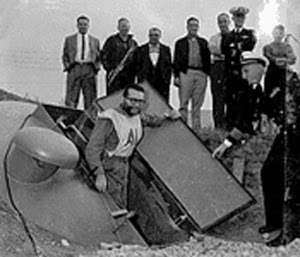 |
|
The Naval Radiological Defense Laboratory at the Hunters Point Naval Shipyard placed prisoners and others in a bomb shelter during exercises simulating a nuclear attack. â Photo courtesy TimePix
|
While sorting through papers, correspondence, news clippings, records etc., I realized that nuclear bomb and nuclear power development has occurred within my lifetime.
It was July 16, 1945, when Trinity, the first atomic bomb, was detonated at Alamogordo nuclear site in New Mexico, followed by the uranium bomb dropped on Hiroshima and the hydrogen bomb on Nagasaki in August…

Vasili Alexandrovich Arkhipov (30 January 1926 â 19 August 1998) was a Soviet naval officer. During the Cuban Missile Crisis, he prevented the launch of a nuclear torpedo and therefore a possible nuclear war. Thomas Blanton (then director of the National Security Archive) said in 2002 that “a guy called Vasili Arkhipov saved the world.”
On 27 October 1962, during the Cuban Missile Crisis, a group of eleven United States Navy destroyers and the aircraft carrier USS Randolph located the diesel-powered nuclear-armed Soviet Foxtrot-class submarine B-59 near Cuba. Despite being in international waters, the Americans started dropping practice depth charges, explosives intended to force the submarine to come to the surface for identification. There had been no contact from Moscow for a number of days and, although the submarine’s crew had earlier been picking up U.S. civilian radio broadcasts, once B-59 began attempting to hide from its U.S. Navy pursuers, it was too deep to monitor any radio traffic, so those on board did not know whether war had broken out. The captain of the submarine, Valentin Grigorievitch Savitsky, believing that a war might already have started, wanted to launch a nuclear torpedo.
Unlike the other subs in the flotilla, on board the B-59 three officers had to agree unanimously to authorize the launch: Captain Savitsky; the political officer Ivan Semonovich Maslennikov; and the second-in-command Arkhipov. Typically, Russian submarines that were armed with the “Special Weapon” only required the captain to get authorization from the political officer if he felt it was necessary to launch the nuclear torpedo, but due to his position as flotilla commander, the B-59’s captain was also required to gain Akrhipov’s approval. An argument broke out among the three, in which only Arkhipov was against the launch.
Although Arkhipov was only second-in-command of submarine B-59, he was commander of the entire flotilla of submarines, including B-4, B-36 and B-130, and equal in rank to Captain Savitsky. According to author Edward Wilson, the reputation Arkhipov gained from his courageous conduct in the previous year’s Soviet submarine K-19 incident also helped him prevail in the debate. Arkhipov eventually persuaded Savitsky to surface the submarine and await orders from Moscow. This action effectively averted the nuclear warfare which most likely would have ensued had the torpedo been fired. The submarine’s batteries had run very low and the air-conditioning had failed, so it was forced to surface amidst its U.S. pursuers and head home. Washington’s message that practice depth charges were being used to signal the submarines to surface never reached B-59, and Moscow claims it has no record of receiving it either.
(read more) (the man who saved the world)

âª#âFutaba⬠âª#âFukushimaâ¬
slogan in the Fukushima evacuation zone means
Nuclear Energy for a Bright Future. It isn’t!
pic.twitter.com/ZuLu7vqcXWâ
14 Mar 2015
