boo!!
hiss!!!

Growing trend to lay fake lawns instead of real grass causes loss of habitat for wildlife and creates waste that will never biodegrade

The long-established MÄori system of environmental management is holistic. It is a system that ensures harmony within the environment, providing a process of, as well as preventing intrusions that cause permanent imbalances and guards against environmental damage. Kaitiakitanga is a concept that has “roots deeply embedded in the complex code of tikangaâ. Kaitiakitanga is a broad notion which includes the following ideas: guardianship, care, wise management. (read more)

I have no country to die for.
My country is the earth.
I am a citizen of the world
which consists of only one race
…the human race.


The clathrate gun hypothesis is the popular name given to the hypothesis that rises in sea temperatures (and/or falls in sea level) can trigger the sudden release of methane from methane clathrate compounds buried in seabeds and permafrost which, because the methane itself is a powerful greenhouse gas, leads to further temperature rise and further methane clathrate destabilization â in effect initiating a runaway process as irreversible, once started, as the firing of a gun.
The sudden release of large amounts of natural gas from methane clathrate deposits in runaway climate change could be a cause of past, future, and present climate changes. The release of this trapped methane is a potential major outcome of a rise in temperature; it is thought that this is a main factor in the global warming of 6°C that happened during the end-Permian extinction, as methane is much more powerful as a greenhouse gas than carbon dioxide (despite its atmospheric lifetime of around 12 years, it has a global warming potential of 62 over 20 years and 23 over 100 years). The theory also predicts this will greatly affect available oxygen content of the atmosphere.
The consequences of a methane-driven oceanic eruption for marine and terrestrial life are likely to be catastrophic. Figuratively speaking, the erupting region “boils over,” ejecting a large amount of methane and other gases (e.g., CO2, H2S) into the atmosphere, and flooding large areas of land. Whereas pure methane is lighter than air, methane loaded with water droplets is much heavier, and thus spreads over the land, mixing with air in the process (and losing water as rain). The air-methane mixture is explosive at methane concentrations between 5% and 15%; as such mixtures form in different locations near the ground and are ignited by lightning, explosions and conflagrations destroy most of the terrestrial life, and also produce great amounts of smoke and of carbon dioxide. Firestorms carry smoke and dust into the upper atmosphere, where they may remain for several years; the resulting darkness and global cooling may provide an additional kill mechanism. Conversely, carbon dioxide and the remaining methane create the greenhouse effect, which may lead to global warming. The outcome of the competition between the cooling and the warming tendencies is difficult to predict. (read more)

Specific structure of a gas hydrate piece

Einstein said, “The splitting of the atom changed everything save man’s mode of thinking; thus we drift towards unparalleled catastrophe.” He also said, “Nuclear power is a hell of a way to boil water.”
The “outer building” surrounding Unit 3 of Fukushima I explodes, presumably due to the ignition of built up hydrogen gas, on March 13, 2011. This is the reactor which has the extremely dangerous plutonium-laced MOX fuel. State of the nuclear reactor core remains unknown…
variations at whats more
the file is suitable for 4×6 high resolution photo prints – please print some and pass them around – no nukes!
fukushima nuclear disaster updates at “whats up”
NO NUKES | RE-TOOL NOW


It is very probable that humanity now possesses the knowledge needed to establish an effective world government. In some way that knowledge must he widely seeded in the consciousness of all mankind. Very soon the hearts of our human family must be touched and warmed so we will welcome a global rule of reason.
The group consciousness of our race is blind, perverse, and easily distracted by trivia when it should be focused on fundamentals. We are entering a critical era. Population pressures will soon create political and economic crisis throughout the world. These will make more difficult and at the same time more needed the building of a rational world society.
A first step will be to convince a doubting world that such a society is now possible. Let us keep in view enduring appeals to the collective reason of humanity. Let us draw attention to the basic problems. Let us establish proper priorities. We must order our home here on earth before we reach for the stars.
Human reason is now awakening to its strength. It is the most powerful agency yet released in the unfolding of life on our planet. We must make humanity aware that acceptance of compassionate, enlightened reason will let us control our destiny within the limits inherent in our nature.
It is difficult to seed wisdom in closed human minds. Cultural inertias are not easily overcome. Unfolding world events and the sad record of our race dramatize the shortcomings of traditional agencies in governing human affairs. The approaching crisis may make mankind willing to accept a system of world law which will stress the responsibility of individual nations in regulating internal affairs, and which will assist them in the peaceful management of international frictions.
With such a system we could eliminate war, We could provide every person an opportunity to seek a life of purpose and fulfillment.
There are alternatives to Armageddon. They are attainable. But they will not happen without coordinated efforts by millions of dedicated people in all nations of the earth.
We, the sponsors of The Georgia Guidestones, are a small group of Americans who wish to focus attention on problems central to the present quandary of humanity. We have a simple message for other human beings, now and in the future. We believe it contains self-evident truths, and we intend no bias for a particular creed or philosophy. Yet our message is in some areas controversial. We have chosen to remain anonymous in order to avoid debate and contention which might confuse our meaning, and which might delay a considered review of our thoughts. We believe that our precepts are sound. They must stand on their own merits.
Stonehenge and other vestiges of ancient human thoughts arouse our curiosity but carry no message for our guidance. To convey our ideas across time to other human beings, we erected a monument â a cluster of graven stones. These silent stones will display our ideas now and when we have gone. We hope that they will merit increasing acceptance and that through their silent persistence they will hasten in a small degree the coming age of reason.
We believe that each human being has purpose. Every one of us is a small but significant bit of the infinite. The celestial alignments of the stones symbolize the need for humanity to be square with External principles which are manifest in our own nature, and in the universe around us. We must live in harmony with the infinite.
Four large stones in the central cluster are inscribed with ten precepts, each stone carrying the same text in two languages. In the English version the message totals fewer than one hundred words. The languages have been selected for their historical significance and for their impact on people now living. Since there are three thousand living languages, not all could he chosen.
We envision a later phase in the development of the Georgia Guidestones. It is hoped that other stones can be erected in outer circles to mark the migrations of the sun and perhaps certain other celestial phenomena. These stones would carry our words in the languages of other individuals who share our beliefs and will raise similar stones at international boundaries in the languages of friendly neighbors. They would serve as reminders of the difficulties which all humanity must face together, and would encourage mutual efforts to deal with them rationally and with justice.
We profess no divine inspiration beyond that which can be found in all human minds. Our thoughts reflect our analysis of the problems confronting humanity in this dawning of the atomic age. They outline in general terms certain basic steps which must be taken to establish for humanity a benevolent and enduring equilibrium with the universe.
Human beings are special creatures. We are shepherds for all earthly life. In this world, we play a central role in an eternal struggle between good and evilâbetween the forces which build and those which would destroy. The Infinite envelops all that exists, even struggle, conflict and change, which may reflect turmoils in the very soul of God.
We humans have been gifted with a small capacity to know and to actâ for good or for evil. We must strive to optimize our existence, not only for ourselves but for those who come after us. And we must not be unmindful of the welfare of all other living things whose destinies have been placed in our trust.
We are the major agency through which good and evil qualities of the spirit become actors in our world. Without us there is very little of love, mercy, or compassion. Yet we can also be agents of hate, and cruelty and cold indifference. Only we can consciously work to improve this imperfect world. It is not enough for us to merely drift with the current. The rational world of tomorrow lies ever upstream.
In 1980, as these stones were being raised, the most pressing world problem was the need to control human numbers. In recent centuries technology and abundant fuels have made possible a multiplication of humanity far beyond what is prudent or long sustainable. Now we can foresee the impending exhaustion of those energy sources and the depletion of world reserves of many vital raw materials.
Controlling our reproduction is urgently needed. It will require major changes in our attitudes and customs. Unfortunately, the inertia of human custom can be extreme. This is especially true when those for whom custom is a dominant force are uninformed of the need for change.
Nearly every nation is now overpopulated in terms of a perpetual balance with nature. We are like a fleet of overcrowded lifeboats confronted with an approaching tempest. In the United States of America we are seriously overtaxing our resources to maintain our present population in the existing state of prosperity. We are destroying our farmland and we have grown dangerously dependent upon external sources for oil, metals and other nonrenewable resources. Nations such as Japan, Holland and Haiti are even more seriously overpopulated and, therefore, in greater jeopardy.
In these circumstances, reproduction is no longer exclusively a personal matter. Society must have a voice and some power of direction in regulating this vital function. The wishes of human couples are important, but not paramount. The interests of present society and the welfare of future generations must be given increasing consideration as we develop mechanisms to bring rational control to our childbearing.
Irresponsible childbearing must be discouraged by legal and social pressures. Couples who cannot provide a decent income and support for a child should not produce children to be a burden for their neighbors. Bringing unneeded children into an overcrowded lifeboat is evil. It is unjust to those children. It is harmful for the other occupants and all living things. Society should not encourage or subsidize such behavior.
Knowledge and techniques for regulating human reproduction are now in existence. Moral and political leaders throughout the world have a grave responsibility to make this knowledge and these techniques generally available. This could be done with a fraction of the funds which the world now devotes to military purpose. In the long run, diverting funds into this channel could do more than anything else to reduce the tensions which lead to war.
A diverse and prosperous world population in perpetual balance with global resources will be the cornerstone for a rational world order. People of good will in all nations must work to establish that balance.
With the completion of the central cluster of The Georgia Guidestones our small sponsoring group has disbanded. We leave the monument in the safekeeping of the people of Elbert County, Georgia.
If our inscribed words are dimmed by the wear of wind and sun and time, we ask that you will cut them deeper. If the stones should fall, or if they be scattered by people of little understanding. we ask that you will raise them up again.
We invite our fellow human beings in all nations to reflect on our simple message. When these goals are some day sought by the generality of mankind, a rational world order can be achieved for all. (read more)

Life is short
Life is hard
Life is precious

“What is wrong with us? Why do we seem to care so little about our own safety, our own health, and the future of our children?” asks Maria Rodale, farmer, author and CEO of Rodale Inc. “Why are we willing to pay thousands of dollars for vitro fertility treatments when we can’t conceive, but not a few extra dollars for the organic food that might help to preserve the reproductive health of our own and future generations?”
In her powerful and informative new book, Organic Manifesto: How Organic Farming Can Heal Our Planet, Feed the World, and Keep Us Safe, Maria Rodale has done all of the thinking and the research about organic farming for us. Yay, we don’t have to think! Following in the path of her grandfather, JI Rodale, who launched Organic Gardening and Farming magazine in 1942 and her father Robert Rodale, who devoted his life to educating others on health and environmental issues, Maria Rodale explains why and how we must immediately begin to undo the damage we have done to the environment and to ourselves.
The ‘Farming System Trial’ that her father, Robert Rodale began in 1990, is now the longest running scientific study comparing ‘synthetic-chemical’ versus ‘organic’ agriculture. After 20 years of experiments, the trial clearly shows that organic farming is not only more productive than chemical farming, especially during times of flood or drought, but that soil farmed organically is a necessary step toward solving our climate crisis. ‘Mycorrhizal fungi’ which grow at the roots of plants, stores carbon. These miraculous fungi build our soil and its health while also sequestering excess carbon and pulling it underground.
(read more) (rodaleinstitute.org)


I apologise in advance to this sort-of-a-downer of a post. I believe there are some things that need to be faced head-on, with our proverbial heads out of the proverbial sand.
This is a post I hoped I would never write. As you, my readers, know, I practice the virtue of chardi kala, translated in many different ways, but all having the meaning of eternal optimism and never giving up. I am still practicing, but it is hard.
No doubt by now you have heard about the massive oil spill by British Petroleum in the Gulf of Mexico in the Caribbean Sea, truly a paradise on earth. Or at least it was until 20 April 2010. On that day the Deepwater Horizon oil rig – owned and run by British Petroleum – exploded, caught fire and began gushing massive amounts of crude oil into the pristine waters around it. Eleven were killed and 17 injured. That was tragic, but it is just the beginning.

The amount of oil gushing into the Gulf is estimated at somewhere between 1,475,000 and 4,200,000 gallons per day ( 5,583,432 and 15,828,729 liters/day). No one knows how much oil is in this well, how long it can keep gushing. Years or decades, if it is not somehow stopped. So far nothing has worked. In fact, efforts have actually made it worse.
Here’s a nice little widget to help you calculate.
Those are pretty dry figures for most people, so here’s a more graphic look. This is what the spill looks like right now (30 June 2010):

I realise that most of my readers really can’t relate to southern Louisiana, so here is the spill in other locations where I have readers:

If I happened to miss your locale, go to Ifitwasmyhome to move the spill to wherever you live.
Perhaps you’d like to see it as it happens.
If that’s not enough to bring it home to you, here are a few oil-soaked pelicans. I find this horribly painful to look at.

In addition, massive amounts of methane gas has been released into the water. This may well turn out to be even more dangerous than the oil. The methane depletes the water of oxygen, leaving all the sea life devoid of the element that is necessary to all life on earth. It is feared that the methane will cause a dead zone where nothing can live, possibly for decades. Also, scientists believe that a huge methane bubble is forming under the water. When it bursts, it could release a tsunami of 20-60 ft (6.1-18.3 m), certainly enough to engulf most of the Caribbean islands. For more information on the gas leak, go here:
Gas Leak 3000 Times Worse Than Oil.
And, by the way, with our current technology we have no way to cap or contain the methane.
I guess that’s not enough bad news. It is now hurricane season. (For those of you in Asia, those are typhoons.) There will be hurricanes. In fact, the first one is blowing right now. Hurricane Alex did not move close to the spill, but there will be another hurricane and another and another.
The next thing to consider is the ocean currents. The Gulf Stream is an ocean river that runs from the Caribbean to Europe.
Eventually this oil and methane and all their problems will reach Europe. They will also travel up the Atlantic coast of North America all the way to Canada and all points north. No one knows how much of the ocean will die. Certainly a large part of the Caribbean Sea will and it will take decades to recover. In the meantime the many people who make their livings along the Gulf, either fishing or in the tourist trade, have lost their means of livelihood. It is even possible that the land they live on will become uninhabitable. Bobby Jindal, the governor of Louisiana has been alerted that a mass evacuation may become necessary, if a hurricane again hits the state. It is likely that once gone, the people will not be allowed to return due to the toxic oil and gas along the coast.
The earth is one big ecosystem, based primarily on our oceans. If a large part of one ocean dies, that will have a cascade effect on the rest of the planet. How far could this go? Worst case scenario: Bye-bye. “Not with a bang, but a whimper.” If you don’t recognise those lines, they are the conclusion of T. S Eliot’s poem, The Hollow Men. To hear the whimper go to Power Without Petroleum and listen hard at 0:25.
Best case scenario: the southern coast of the United States becomes uninhabitable for a period of time and much of the sea life in the Gulf of Mexico dies, with devastating consequences to the people who now live there. As it is impossible that there be no hurricanes in the season, we can be sure that the winds will carry the oil throughout the region, damaging all it touches. That damage cannot be estimated at this time, except to say it will be extensive.
This morning (1 July 2010), going through my inbox, I found this article in the daily UN bulletin:
Biologists find ‘dead zones’ around BP oil spill in Gulf
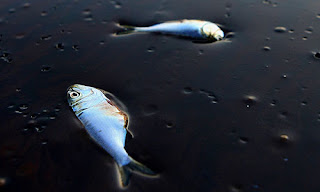
Methane at 100,000 times normal levels have been creating oxygen-depleted areas devoid of life near BP’s Deepwater Horizon spill, according to two independent scientists

As long as I can remember, the scientists have been screaming “Wolf!” alerting us to this or that which they claim is going to wipe us out. As I child I grew up with “nuclear annihilation.” That was the biggie. There have been others: the hole in the ozone layer, swine flu (twice), bird flu, global climate change and I’m sure others that I have forgotten. And it seems, life causes cancer. There is truth in all these scientific assertions, but there was also something we could do to stop or at least alleviate the disaster. As I see it, this is different because we are helpless to do anything except pray. Of course, I am not a scientist, and the only way I see out of this is divine intervention. Even if the spill can somehow be stopped, we can do nothing about the methane. This is the time more than ever before that we need to dig deep within ourselves and find the high spirits, the chardi kala, that is a part of us. It takes courage to look tragedy in the face and carry on without panic or depression.
And what caused all this? Of course it was British Petroleum cutting corners on safety to save money and increase profit. It was Pres. Clinton who authorised the deep sea drilling. It was Pres. George W. Bush who so favoured the oil interests and permitted a lack of oversight to allow BP not to follow the safety measures. It was Pres. Obama who did not immediately step in to correct this corruption from the previous administration. But it was also all of us who are dependent on petroleum, who refuse to cut back on our usage, we who demand more and more. In the end, if we had not demanded this oil, if we had lost our lust it, BP wouldn’t have been able to make the profit that drove them to build this rickety structure upon the rickety structure of our economy. So what now? We have learned why greed is such an evil thing. Whither our good, green beautiful earth?
I keep thinking about the ending of Dr. Strangelove. (A great movie. If you haven’t seen it, I highly recommend you see it while you still can.)
Remain in chardi kala, my dear brothers and sisters!

pictures:
the fire – United States Coast Guard (via Wikipedia)
dead fish – Sean Gardner (Reuters)
the pelicans – Charlie Riedel (AP)
the earth – courtesy of NASA
