I dream of a Star Trek world. This think tank will focus on creative actions
designed to initiate a global paradigm shift towards a world where racism, poverty
and war will be a thing of the past.

Category: pollution

whats up: Nukespeak is a classic! | Karl Grossman


Nukespeak is a classic!

Award-winning investigative journalist Karl Grossman interviews Nukespeak co-author Rory O’Connor on Grossman’s nationally-aired TV program, Enviro-Close-Up. Grossman has been a journalist for more than 40 years, and is a professor of journalism at the State University of New York/College at Old Westbury. He is also the chief investigative reporter for WVVH-TV.

Grossman said he was happy to be talking about the 30th anniversary updated edition of Nukespeak: “Of the books written about nuclear technology through the years, Nukespeak is a classic. The new edition of Nukespeak has been updated — with four new chapters — and added to its title is: The Selling of Nuclear Technology from the Manhattan Project to Fukushima. It tells how nuclear promoters have been — and continue — using Orwellian language to try to hide the truth about the deadly dangers of nuclear technology.”


more > whats up: Nukespeak is a classic! | Karl Grossman


EnviroVideo presents Enviro Close-UP with Karl Grossman on blip.tv

A EnviroVideo produces environmental and social justice programs for television – including interview and news shows, specials, and documentaries. The underlying premise of EnviroVideo is that there are critical environmental issues at hand that can best be communicated to large numbers of people through the media most favored for news and information – television and the Internet. And if there is broad public awareness, pressing environmental matters can be dealt with and action taken to truly resolve them.


NO NUKES | RE-TOOL NOW
whats up: RC’S NUCLEAR BLOG


Annya’s story – a Chernobyl legacy | whats up: 25th Anniversary of Chernobyl Nuclear Disaster | NUCLEAR “SAFTEY” = NUCLEAR THREAT

Annya's story – a Chernobyl legacy

Belarus: Annya’s parents lived in a town so contaminated by the Chernobyl nuclear disaster that it was destroyed and buried. When she was four Annya was diagnosed with a brain tumor…


more

• whats up: 25th Anniversary of Chernobyl Nuclear Disaster | NUCLEAR "SAFTEY" = NUCLEAR THREAT

• whats up: RC'S NUCLEAR BLOG

After the first few posts it became basically a news blog about the ongoing Fukushima Nuclear Catastrophe with related nuclear news and commentary – not so random anymore, it has become progressively more activist...


NO NUKES | RE-TOOL NOW


telling the truth about radiation


Japan Crowd Funding.mp4

A story telling the truth about radiation from Fukushima nuclear disaster. This video is to raise funds for our crowd funding campaign for ‘In Transition 2’. If you want to see how Transition Initiatives are responding to the situation then please donate! The money will pay for a film maker to shoot a story about the importance of setting up local renewable energy companies.


Breaking the Information Monopoly | Nukespeak

How do we know whether to believe what government officials tell us about the danger of radiation after a nuclear accident like Fukushima New technologies are making it possible for citizens to break the government’s information monopoly, so that citizens can double-check the “no danger” announcements that government officials tend to issue after nuclear accidents.

Nukespeak | Nuclear Language, Myths and Mindset


NO NUKES | RE-TOOL NOW
whats up nuclear blog


Lies, Damn Lies, and Safe Nuclear Power


Rankin & Dub Ainu Band “You can’t see it, and you can’t smell it either “

english subtitles

Radiation is scary, radiation is dangerous, you can’t see or smell it, and you can’t run from it


Independent Media Center | www.indymedia.org | ((( i ))): “Lies, Damn Lies, and Safe Nuclear Power – by Stephen Lendman

In any form, nuclear power is inherently unsafe. For decades, nuclear expert Helen Caldicott warned it must be abandoned, saying:

‘As a physician, I contend that nuclear technology threatens life on our planet with extinction. If present trends continue, the air we breathe, the food we eat, and the water we drink will soon be contaminated with enough radioactive pollutants to pose a potential health hazard far greater than any plague humanity has ever experienced.’

Anti-nuclear activist/expert Professor Karl Grossman agrees, calling ‘Atomic Energy: Unsafe in the Real World’ in his June 29 article, saying:

‘Nuclear power requires perfection and no acts of God’ to avoid accidents that may become catastrophes. Humans and technology aren’t perfect. Natural and other type disasters happen. ‘(W)e can’t eliminate them. But we can – and must eliminate atomic energy’ or it will eliminate us.

On March 18, Bloomberg said Japan’s Fukushima disaster ‘follows decades of falsified safety reports, fatal accidents and underestimated earthquake risks in Japan’s atomic power industry.’

The same is true in America and elsewhere – governments, regulators, and power companies suppressing vital truths, instead of shutting down inherently unsafe plants, making all of them ticking bombs…”


whats up: You can't see it, and you can't smell it either | Nuclear Nightmare Unfolding: “Everyone knows about Chernobyl, Three Mile Island and, now, Fukushima. But what about Semipalatinsk, Palomares and Kyshtym? The world is full of nuclear disaster zones — showing just how dangerous the technology really is.”

Plastiki


The Plastiki is a 60-foot (18 m) catamaran made out of 12,500 reclaimed plastic bottles and other recycled PET plastic and waste products. The craft was built using cradle to cradle design philosophies and features many renewable energy systems, including solar panels, wind and trailing propeller turbines, and bicycle generators. The frame was designed by Australian naval architect Andrew Dovell. The boat’s name is a play on the 1947 Kon-Tiki raft used to sail across the Pacific by Norwegian explorer Thor Heyerdahl, and its voyage roughly followed the same route.

(read more) (theplastiki.com) (video clip) (junk)

World Water Day


World Water Day has been observed on March 22 since 1993 when the United Nations General Assembly declared March 22 as World Day for Water.

This day was first formally proposed in Agenda 21 of the 1992 United Nations Conference on Environment and Development (UNCED) in Rio de Janeiro, Brazil. Observance began in 1993 and has grown significantly ever since; for the general public to show support, it is encouraged for the public to not use their taps throughout the whole day, the day has become a popular Facebook trend.

In addition to the UN member states, a number of NGOs promoting clean water and sustainable aquatic habitats have used World Day for Water as a time to focus public attention on the critical water issues of our era. Participating agencies and NGOs have highlighted issues such as a billion people being without access to safe water for drinking and the role of gender in family access to safe water.
(read more)

Water is an essential resource for life and good health. A lack of water to meet daily needs is a reality today for one in three people around the world.

Globally, the problem is getting worse as cities and populations grow, and the needs for water increase in agriculture, industry and households.

This fact file highlights the health consequences of water scarcity, its impact on daily life and how it could impede international development. It urges everyone to be part of efforts to conserve and protect the resource. (WHO water facts)

thanks BP

Minamata

W. Eugene Smith
Tomoko Uemura in Her Bath
Minamata, 1972

People who are easily shocked

should be shocked more often

Sorry Ain’t Enough…

There is nothing left
to you
at this moment
but to have a good/big laugh.
from the Zen.

Drop in the ocean

The broken BP rig is leaking about 8,820 tons of crude oil into the Gulf every day. It is sickening the ocean and killing marine life. Believe me, I grieve. However, what worries me even more is what we don’t see. A little over half that amount gets burned and released as auto emissions into the skies of Los Angeles every day. That’s somewhere in the vicinity of 4,740 tons of hydrocarbons a day. It is sickening the air we breathe and causing debilitating respiratory problems. Sustained exposure to hydrocarbons compromises the body’s defense system resulting in ailments such as chronic bronchitis and pneumonia. If you don’t believe me, check out an emergency room in L.A on a smoggy summer day. What is even more insidious is what crosses the mother’s placenta, and gets absorbed by the human fetus. Toxins related to hydrocarbons are known to impair prenatal development. This accounts for a higher incidence of developmental disorders such as autism, attention deficit, hyperactivity and dyslexia. Sometimes impairment doesn’t show up until later in life when it becomes visible as signs of depression or schizophrenia. I believe the human suffering caused by addiction to fossil fuel is immeasurable. It makes the Gulf oil spill seem like a drop in the ocean.

Deepwater Nightmare


The Deepwater Horizon drilling rig explosion occurred on April 20, 2010 on the semi-submersible offshore drilling rig Deepwater Horizon in the Gulf of Mexico.

Survivors described the incident as a sudden explosion which gave them less than five minutes to escape as the alarm went off. After having been on fire for more than a day, Deepwater Horizon sank on April 22, 2010 in 5,000 feet of water. 115 of the 126 member crew were recovered, and eleven remain missing.

Although initially the undersea wellhead appeared to be contained, on 24 April it was found that the wellhead was damaged and was leaking oil into the Gulf. Coast Guard Rear Admiral Mary Landry described it as “a very serious spill, absolutely.” BP plans to use remotely operated vehicles (ROVs) to close the well at depth; up to 19,000 barrels of oil a day is estimated to be leaking from the wellhead. The valve closing procedure was estimated to take 24 to 36 hours as of April 25; oil cleanup was being hampered by high waves on April 24 and 25. By April 25, the oil spill covered 1500 square km, and was only 50 km from the Chandeleur Islands, ecologically sensitive barrier islands already damaged by Hurricane Katrina. (read more)

Pigs In Space

Deepwater Horizon begins gushing oil into the Gulf of Mexico.

Corporate Murder

“We are not expendable. We are not flowers offered at the altar of profit and power. We are dancing flames committed to conquering darkness and to challenging those who threaten the planet and the magic and mystery of life.”
Rashida Bee, Bhopal gas leak survivor

The Union Carbide disaster, also known as the Bhopal disaster or the Bhopal gas tragedy, was an industrial catastrophe that took place at a Union Carbide pesticide plant in the Indian city of Bhopal, Madhya Pradesh on December 3, 1984. Around 12 AM, the plant released methyl isocyanate (MIC) gas and other toxins, resulting in the exposure of over 500,000 people. Estimates vary on the death toll; the official immediate death toll was 2259, which rose greatly over time. The government of Madhya Pradesh has confirmed a total of 3787 deaths related to the gas release. Another source says that a few days later the death toll had doubled. Over the next few years, the lingering effects of the poison nearly doubled the toll again, to about 15,000, according to government estimates. Local activists say the real numbers are almost twice that. Others estimate 8000 to 10,000 died within 72 hours and 25,000 have since died from gas-related diseases.

Some 25 years after the gas leak, 390 tonnes of toxic chemicals abandoned at the Union Carbide plant continue to leak and pollute the ground water in the region and affect thousands of Bhopal residents who depend on it.

(read more)

Junk Yard Man

You are not content with

polluting your planet

Now you have made your

outer space a junk yard too

Within the vast debris field

there are tens of millions of

small fragments and an estimated

19,000 at 1 kilogram (2.2 lb) or heavier

The Kessler Syndrome will soon render

space exploration, and even the use of

satellites, infeasible for many generations

The Chemical Edge

This little piggy went to market,

This little piggy stayed at home,

This little piggy had roast beef,

This little piggy had none…

And this little piggy is an example

of what chemical and toxic pollution

is doing to biological life forms,

meaning us, the cause of it all,

we are the little guinea piggies,

and we will be the ones that go…

“Wee wee wee” all the way home.

(read more)

Earth Creatures

We were here

before you were

Coastal zone

We used to call them swamps. Oil companies dumped sludge into them. Real estate developers excavated them ..and built pricey coastal communities like Marina Del Rey. Just north of there, surfers in Santa Monica began getting sick ..with symptoms ranging from skin rashes to heart attacks. I used to get ear infections. Investigators discovered high levels of toxins in the water ..both natural and man-made ..and began closing beaches for like months at a time. We don’t call them swamps any longer. They’re ‘estuaries’ ..and they serve a purpose .. filtering runoff before it goes into the ocean ..removing contaminants .. keeping the shoreline hospitable ..and the ocean sustainable (ask a fisherman). The Bolsa Chica wetlands is the only one remaining in Southern California that hasn’t been developed to the point where it’s lost all of that. A 40-year old feud between developers and environmentalists has kept it that way. Fanatical environmentalists. I’ll bet you there’s not one person surfing the nearby river jetty who hasn’t gotten sick.

Elon Musk

Elon Musk (born 1971) is an American engineer, entrepreneur and philanthropist best known for co-founding PayPal, SpaceX and Tesla.

He is currently the CEO and CTO of SpaceX, CEO and Product Architect of Tesla Motors and Chairman of SolarCity.

A Sea of Plastic


Just for worldwide consumption of bottled water in 2004 alone it took roughly 87.4 million barrels of oil. You can imagine that with statistics for 2008, we have a figure in the hundreds of millions of barrels of oil being used just to produce bottled water. Don’t buy water in plastic bottles, water is free!

America and the world’s addiction to plastic doesn’t end there. Plastic bags take oil, just like plastic bottles to produce. Currently the U.S. consumes 100 billion plastic shopping bags in a year and worldwide consumption is estimated to be from 500 billion to 1 trillion plastic bags a year. That is roughly 1 million plastic bags a minute being consumed and less than 1% is recycled. If we legalize hemp we could make bags from a profitable and sustainable source and avoid wasting all that oil and energy making “trash that lasts forever.”

I guess it’s okay to pollute our waters now because, “we can $ell them clean water in a pla$tic bottle.” Clean water is a right, not a commodity to be exploited. I bet next they will try to $ell us air and fire and dirt.

Sperm

In the 1950’s the average sperm count was 120 million per milliliter. The average sperm count today has been halved to an average of around 60 million per milliliter in the Western world, a decrease of 1-2% per year.

My guess is that all the poisons, chemicals and female hormone mimicking compounds we’ve introduced into our environment and food have begun to concentrate in our bodies and are slowly trying to turn boys into girls. Male infertility will be the method of our self-annihilation. We are killing ourselves and the planet with our waste.

Plastic in the ocean (Plastic is forever)


This is Genevieve Johnson speaking to you from the Odyssey in the Canary Islands.

When I reflect on our time researching at sea over the past five years, two unrelated things stand out – sperm whales and plastics.

We are not always assured of finding sperm whales. However, even in the most remote regions of the ocean, plastics are guaranteed. Unfortunately, the relationship between plastics and all marine life is far more intricate than most of us could possibly imagine.


The numerous benefits of modern society’s productivity make almost all of us utterly addicted to plastic products. Most of the products we use on a daily basis include, or are contained in plastic. We drink out of them, eat off them, carry food and clothing in them, sit on them and drive in them. Plastics are durable, lightweight and can be made into virtually anything. It is these very practical and useful properties of plastics that make them so harmful when they make their way into the oceans. Unfortunately, most of us give little thought to where plastics come from or where they end up after they have served our brief purpose.

The vastness of the ocean is incomprehensible to those who have never spent any time at sea. Yet, as we gaze out over the horizon from onboard Odyssey over what most of us imagine is a pristine seascape, we are continually confronted with a sea of plastic.

Historically, humans have always tossed waste into the ocean but marine organisms broke it down in a relatively short time. Unfortunately, our quest for convenient packaging over the past 50 years or so, created a class of plastic products that are immune to even the most rapacious bacteria.


Despite the era of recycling, only 3.5% of plastics are recycled in any way throughout the world. Today, plastic debris causes considerable, widespread mortality of marine wildlife, including mammals, birds, turtles and fish through entanglement in monofilament plastic fishing gear and ingestion. Turtles mistake plastic bags for jellyfish and other prey. Seabirds, particularly Albatross, mistake plastics floating at the surface for food and ingest them while foraging. Three hundred thousand cetaceans drown annually in fishing gear, while necropsy records of several stranded cetaceans, including large whales and particularly dolphins, reveal the ingestion of plastic debris.

The problem with plastics is they do not biodegrade. When something biodegrades, naturally occurring organisms break down natural materials into their simple chemical components. For example, when paper breaks down it becomes carbon dioxide and water. However, plastic is a synthetic material and never biodegrades. Instead it undergoes a process called ‘photodegredation’, whereby sunlight breaks it down into smaller and smaller pieces over very long periods of time. A disposable diaper takes an estimated 500 years to break down while plastic 6-pack rings for cans take 400 years and a plastic water bottle can take up to 450 years to degrade. However, this does not mean they will disappear, all remain as plastic polymers and eventually yield individual molecules of plastic too tough for any organism to digest.

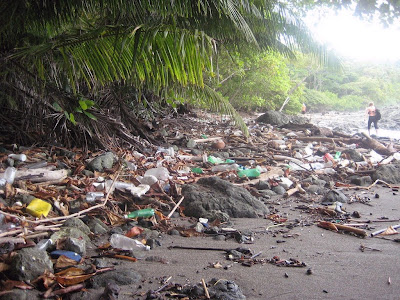
In 2001, the Algalita Marine Research Foundation based in Long Beach California led by Captain Charles Moore, conducted a survey thousands of miles out to sea in a remote region of the Pacific Ocean known as the North Pacific subtropical gyre in an effort to assess the extent of the problem of plastic pollution in the ocean. Gyres are areas where oceanographic convergences and eddies cause debris fragments to accumulate naturally. What the researchers discovered was both shocking and outrageous, a floating mass of plastic junk stretching across an area of ocean the size of Texas. Rivers of soda and water bottles, spray can tops, candy wrappers, cigarette lighters, shopping bags, polypropylene fishing nets, buoys and unidentifiable, miscellaneous fragments collected in a huge rotating mass of plastic pollution.
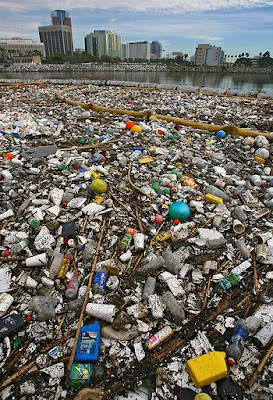

In addition to large obvious pieces of plastic, the results of the survey revealed minute plastic fragments mixed with tiny sea creatures. The published results from the survey reveal a sea of plastic soup comprising “six pounds of plastic floating in the gyre for every pound of naturally occurring zooplankton.” Charles Moore now believes “plastic debris is the most common surface feature of the world’s oceans.”

Until now, no studies were conducted on filter-feeding organisms such as jellies, whose feeding mechanisms do not permit them to distinguish between tiny fragments of plastic debris and plankton, and no studies to assess potential effects on these filter-feeders. It is now known that plastic fragments heavily impact these creatures. When broken into smaller pieces, these tiny plastic fragments accumulate non-water soluble toxicants such as PCB’s, and pesticides such as DDT. Plastic polymers, or tiny plastic resin pellets act as sponges for these chemicals and other persistent organic pollutants, concentrating such poisons up to one million times higher than their concentration in the water as free floating substances.

The implications and scope of the problem is astounding considering about 250 billion pounds of plastic pellets are produced annually worldwide for use in the manufacture of various plastic products. When these products break down into fragments and disperse throughout the oceans, they concentrate and transport toxicants. In the North Pacific oceanic gyre, Moore and his team witnessed filter feeding jellies or salps with brightly colored plastic fragments in their stomachs. Fish consumed by larger and larger predators in turn eat these tiny organisms, all the while the toxicants continue to climb and concentrate up the food chain. In many cases, this chemical pathway leads directly to human beings. Many of these chemicals are ‘hormone mimics’ and ‘endocrine disruptors’ and are released into the body when plastic is ingested. The effects of hormone disruption on humans can range from birth defects to cancers.
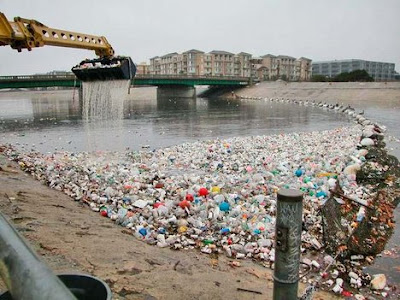

The facts are daunting and the future looks grim. Moore and his colleagues currently predict a 10-fold increase in plastic in the ocean by 2010 bringing the ratio of 60 pounds of surface plastic to every one pound of zooplankton in the North Pacific gyre.

In the meantime, it is up to all of us to be aware that we share one fragile earth, sustained by one ocean system. We can all contribute to its demise, but more importantly we are all responsible for the conservation of our marine environment and the amazing life it supports. We do not need to make sacrifices in our lives, only minor modifications. We can help minimize the impact by being responsible about the amount of plastic products we consume. Unfortunately labeled recycling bins are not always reliable; if possible reduce the amount of plastic products you purchase by searching for alternative materials and reuse plastics where possible. We can all make a difference.

Tesla Motors

The Tesla Roadster is a plug-in electric car with a range of over 200 miles. The new “Model S” sedan will have a range of 300 miles. This is what we’ve been waiting for.


Referring to the Tesla Roadster, California Governor Arnold Schwarzenegger said, “I test drove this vehicle, and it is hot.”

“Disposable” plastic

“Disposable” plastic……..

is trash that lasts forever.

Junk

Sailing to Hawaii on 15,000 plastic bottles and a Cessna 310, to raise awareness about plastic fouling our oceans……..Junk.

Think Tank Alumni

Links

GlobaLove Think Tank is a subsidiary of

To join our Think Tank you can e-mail me for an invitation

Hit Counter

Notable Organizations

Truth Is Coming

Must See Documentaries

Blog Archive

Labels