


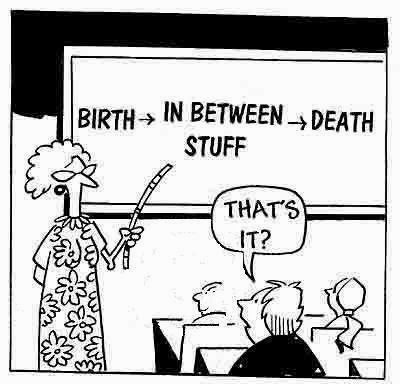
One of these days I’ll be gone…
one of these days I’ll be dead…
i was once like you…
you will soon be like me…
one of these days I’m gonna do something…
I don’t know what yet but it’s gonna be good…
one of these days I’m gonna make a difference…


The Mahavatar is in constant communion with Christ; together they send
out vibrations of redemption, and have planned the spiritual technique
of salvation for this age.
The work of these two fully-illumined
mastersâone with the body, and one without itâis to inspire the nations
to forsake suicidal wars, race hatreds, religious sectarianism, and the
boomerang-evils of materialism.
Babaji is well aware of the trend of
modern times, especially of the influence and complexities of Western
civilization, and realizes the necessity of spreading the
self-liberations of yoga equally in the West and in the East. (read more)


The Zentai Project
 is a group of people
 who go out in public
 wearing Zentai suits
 for the amusement of themselves
 and the public.

Sir Christopher Frank Carandini Lee, CBE, CStJ (27 May 1922 â 7 June 2015) was an English actor, singer, and author. With a career spanning nearly 70 years, Lee initially portrayed villains and became best known for his role as Count Dracula in a sequence of Hammer Horror films. His other film roles include Francisco Scaramanga in the James Bond film The Man with the Golden Gun (1974), Saruman in The Lord of the Rings film trilogy (2001â2003) and The Hobbit film trilogy (2012â2014), and Count Dooku in the final two films of the Star Wars prequel trilogy (2002 and 2005) and Star Wars: The Clone Wars (2008).
Lee was knighted for services to drama and charity in 2009, received the BAFTA Fellowship in 2011 and received the BFI Fellowship in 2013. Lee considered his best performance to be that of Pakistan’s founder Muhammad Ali Jinnah in the biopic Jinnah (1998), and his best film to be the British horror film The Wicker Man (1973).
Always noted as an actor for his deep strong voice, Lee was also known for his singing ability, recording various opera and musical pieces between 1986 and 1998 and the symphonic metal album Charlemagne: By the Sword and the Cross in 2010 after having worked with several metal bands since 2005. The heavy metal follow-up titled Charlemagne: The Omens of Death was released on 27 May 2013. He was honoured with the “Spirit of Metal” award in the 2010 Metal Hammer Golden God awards ceremony. (read more) (christopher lee filmography)
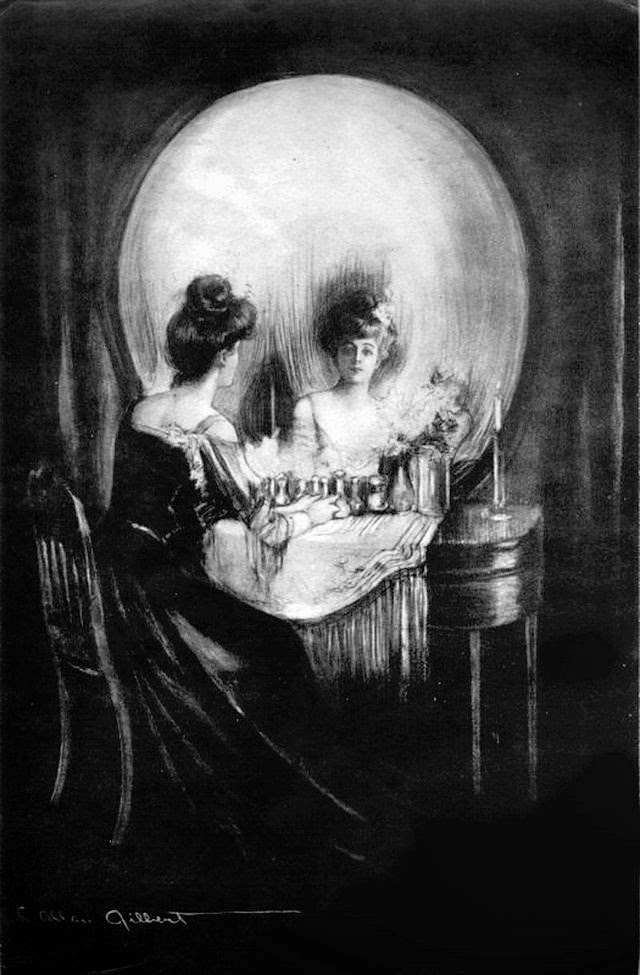
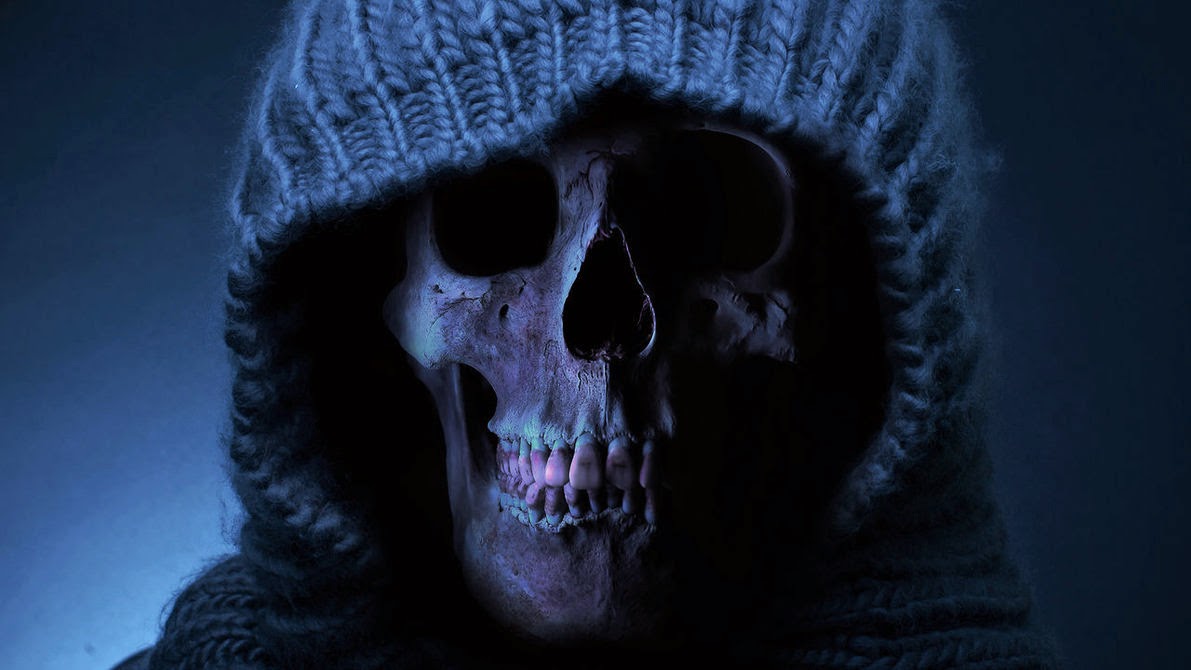
I once knew a man
who says death smiles at us all
all a man can do is smile back
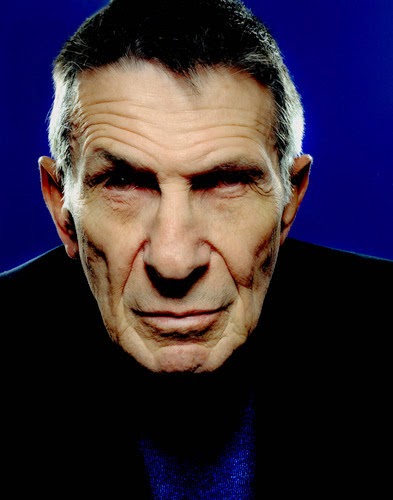
Leonard Simon Nimoy (March 26, 1931 â February 27, 2015) was an American actor, film director, poet, singer and photographer. Nimoy was known for his role as Spock in the original Star Trek series (1966â69), and in multiple film, television and video game sequels.
Nimoy was born to Jewish immigrant parents in Boston, Massachusetts. He began his career in his early twenties, teaching acting classes in Hollywood and making minor film and television appearances through the 1950s, as well as playing the title role in Kid Monk Baroni. Foreshadowing his fame as a semi-alien, he played Narab, one of three Martian invaders in the 1952 movie serial Zombies of the Stratosphere. From 1953-1955, he served in the United States Army.
In 1965, he made his first appearance in the rejected Star Trek pilot The Cage, and went on to play the character of Mr. Spock until 1969, followed by eight feature films and guest slots in the various spin-off series. The character has had a significant cultural impact and garnered Nimoy three Emmy Award nominations; TV Guide named Spock one of the 50 greatest TV characters. After the original Star Trek series, Nimoy starred in Mission: Impossible for two seasons, hosted the documentary series In Search of…, and narrated Civilization IV, as well as making several well-received stage appearances. More recently, he also had a recurring role in the science fiction series Fringe.
Nimoy’s fame as Spock was such that both of his autobiographies, I Am Not Spock (1975) and I Am Spock (1995), were written from the viewpoint of sharing his existence with the character.
Nimoy’s greatest prominence came from his role in the original Star Trek series. As the half-Vulcan, half-human Spockâa role he chose instead of one on the soap opera Peyton PlaceâNimoy became a star, and the press predicted that he would “have his choice of movies or television series”. He formed a long-standing friendship with Shatner, who portrayed his commanding officer, saying of their relationship, “We were like brothers.” Star Trek was broadcast from 1966 to 1969. Nimoy earned three Emmy Award nominations for his work on the program.
He went on to reprise the Spock character in Star Trek: The Animated Series and two episodes of Star Trek: The Next Generation. When a new Star Trek series was planned in the late 1970s, Nimoy was to be in only two out of eleven episodes, but when the show was elevated to a feature film, he agreed to reprise his role. The first six Star Trek movies feature the original Star Trek cast including Nimoy, who also directed two of the films. He played the elder Spock in the 2009 Star Trek movie and reprised the role in a brief appearance in the 2013 sequel, Star Trek Into Darkness, both directed by J. J. Abrams.
Spock’s Vulcan salute became a recognized symbol of the show and was identified with him. Nimoy created the sign himself from his childhood memories of the way kohanim (Jewish priests) hold their hand when giving blessings. During an interview, he translated the priestly blessing from Numbers 6:24â26 which accompanies the sign and described it during a public lecture:
May the Lord bless and keep you and may the Lord cause his countenance to shine upon you. May the Lord be gracious unto you and grant you peace. The accompanying spoken blessing, “Live long and prosper.” (read more)

Shirley Temple Black (April 23, 1928 â February 10, 2014) was an American film and television actress, singer, dancer and public servant, most famous as Hollywood’s number one box-office star from 1935 through 1938. As an adult, she entered politics and became a diplomat, serving as United States Ambassador to Ghana and later to Czechoslovakia, and as Chief of Protocol of the United States.
Temple began her film career in 1932 at the age of three. In 1934, she found international fame in Bright Eyes, a feature film designed specifically for her talents. She received a special Juvenile Academy Award in February 1935 for her outstanding contribution as a juvenile performer to motion pictures during 1934, and film hits such as Curly Top and Heidi followed year after year during the mid-to-late 1930s. Licensed merchandise that capitalized on her wholesome image included dolls, dishes and clothing. Her box office popularity waned as she reached adolescence. She appeared in a few films of varying quality in her mid-to-late teens, and retired completely from films in 1950 at the age of 22. She was the top box-office draw in Hollywood for four years in a row (1935â38) in a Motion Picture Herald poll.
Temple returned to show business in 1958 with a two-season television anthology series of fairy tale adaptations. She made guest appearances on television shows in the early 1960s and filmed a sitcom pilot that was never released. She sat on the boards of corporations and organizations including The Walt Disney Company, Del Monte Foods and the National Wildlife Federation. She began her diplomatic career in 1969, with an appointment to represent the United States at a session of the United Nations General Assembly. In 1988, she published her autobiography, Child Star.
Temple was the recipient of numerous awards and honors including the Kennedy Center Honors and a Screen Actors Guild Life Achievement Award. She ranks 18th on the American Film Institute’s list of the greatest female American screen legends of all time.
(read more)